Why can't you just swallow BPC-157? What your stomach does to peptides
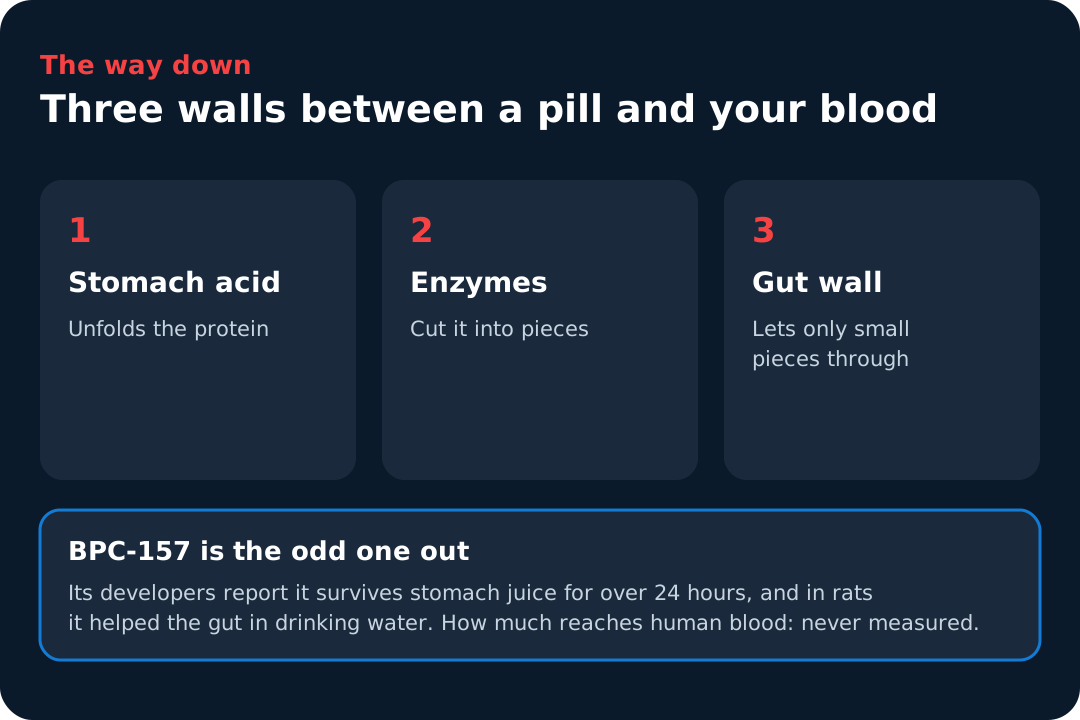
Your stomach is built to break down protein, and peptides are small proteins. That is why almost every peptide medicine is a shot. BPC-157 is the odd one out: it was first found in human stomach juice, and its developers say it survives there for more than a day.

In short
- Stomach acid and enzymes break peptides down, and the gut wall lets very little through
- The semaglutide pill (Rybelsus) needs an absorption helper and still gets only 0.4% to 1% into the blood
- BPC-157 comes from a protein in human gastric juice. Its developers report it stays intact there for over 24 hours
- In rats, BPC-157 in the drinking water helped a damaged food pipe and other gut problems
- No published human study has measured how much swallowed BPC-157 reaches the blood
Why most peptides are shots
Your stomach is made to take protein apart. Acid unfolds it, enzymes cut it into pieces, and the gut wall only lets small pieces through. A peptide is a short protein, so it gets the same treatment.
The best example is semaglutide, the drug in Ozempic. It also comes as a pill, Rybelsus, and that pill had to be built around an absorption helper called SNAC, which helps it get absorbed through the stomach wall. The pill has to be taken on an empty stomach in the morning with a small sip of water, and you then wait at least 30 minutes before eating.
Even with all that, only about 0.4% to 1% of the dose gets into the blood. The newer Ozempic tablets on the same label reach 1% to 2%.
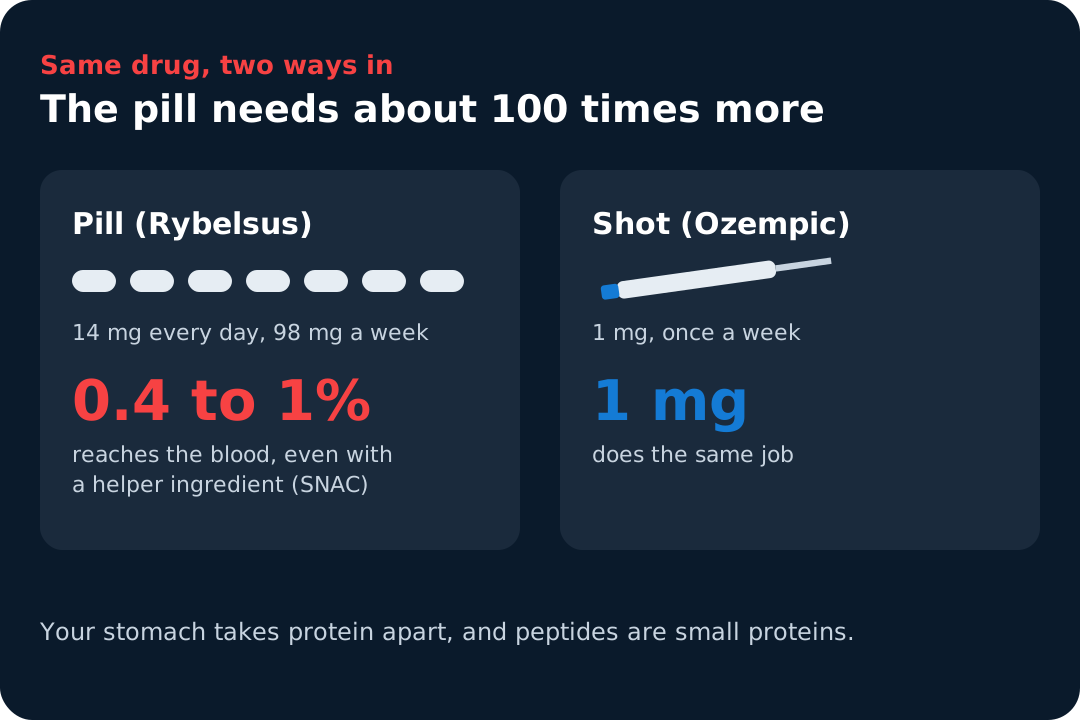
You can see it in the doses. The top Rybelsus dose is 14 mg every day. The Ozempic shot does the job with 1 mg once a week, up to 2 mg. That is roughly 100 times more drug by mouth for the same effect.
BPC-157 started in the stomach
BPC-157 is a chain of 15 amino acids. Researchers at the University of Zagreb in Croatia found it as part of a protein in human gastric juice, and they describe it as "native to and stable in human gastric juice (for more than 24 h)".
Two things to keep in mind:
- It's their claim. Nearly all BPC-157 research comes from that one group, the same people who developed it. The reviews repeat the stability finding but don't show the experiment.
- Surviving the stomach isn't the same as getting into the blood. A peptide can stay intact in stomach juice and still barely cross the gut wall.
In rats, the drinking water worked for the gut
The Zagreb group gave BPC-157 by mouth in many rat studies, simply dissolved in the drinking water.
In one, rats had long-term damage to the food pipe (oesophagitis) and a weak valve between the food pipe and stomach. BPC-157 in the drinking water, at 0.16 micrograms per ml, healed the damage and restored the pressure in the valve. The same dose given as a shot worked too.
The same lab, with Sikiric as senior author, reported results with BPC-157 in drinking water for colitis, short bowel syndrome, gut damage from the painkiller diclofenac and fistulas between the bowel and the skin. It also used drinking water in a knee ligament study, where it helped healing just like the shot and the cream.
So in rats, swallowing it seems to work, at least for the gut, where it doesn't have to travel far.
And in people?
This is where it gets thin. We found:
- One oral trial, no results. A phase 1 trial of BPC-157 tablets (1 mg each) in healthy volunteers was registered in 2015. Its status is unknown and it has never posted results.
- No absorption data. No published study has measured how much swallowed BPC-157 reaches human blood. The one detailed study of how BPC-157 moves through the body tested shots into a vein and a muscle in rats and dogs, not swallowing.
- Very few human studies of any kind. A 2025 review counted only three small pilot studies of BPC-157 in people, none of them by mouth.
So how do BPC-157 capsules work?
Honestly: nobody has shown it in people. Here is what the evidence does and doesn't support:
| Claim | What the evidence says |
|---|---|
| BPC-157 survives stomach juice | Reported by the lab that developed it, for over 24 hours |
| Swallowed BPC-157 helps gut problems | Shown in rats, many studies, one lab |
| Swallowed BPC-157 reaches the blood | Not measured in any published study |
| Capsules work for injuries elsewhere in the body | Rat drinking water healed a knee ligament; never tested in people |
If BPC-157 works by mouth anywhere, the gut is the most likely place, because that is where it lands. For anything else, like a sore shoulder, a capsule is a bet on rat data.
I don't gatekeep.
Tell me what you're after and where you live. I'll email you my source.
Sources 13 studies and labels
- Sikiric et al. (2020). Fistulas healing, stable gastric pentadecapeptide BPC 157 therapy. Current Pharmaceutical Design. PubMed 32329684
- Rybelsus and Ozempic tablets (oral semaglutide) US label. DailyMed
- Ozempic (semaglutide injection) US label. DailyMed
- Sikiric et al. (2022). Cytoprotective gastric pentadecapeptide BPC 157. World Journal of Gastroenterology. PubMed 35125818
- Petrovic et al. (2006). Prolonged esophagitis with sphincter failure in the rat and BPC 157. Journal of Pharmacological Sciences. PubMed 17116974
- Klicek et al. (2013). BPC 157 and cysteamine colitis in rats. Journal of Physiology and Pharmacology. PubMed 24304574
- Sever et al. (2009). BPC 157 and short bowel syndrome in rats. Digestive Diseases and Sciences. PubMed 19093208
- Ilic et al. (2011). BPC 157 and diclofenac toxicity in rats. Life Sciences. PubMed 21295044
- Klicek et al. (2008). BPC 157 and colocutaneous fistula healing in rats. Journal of Pharmacological Sciences. PubMed 18818478
- Cerovecki et al. (2010). BPC 157 improves ligament healing in the rat. Journal of Orthopaedic Research. PubMed 20225319
- ClinicalTrials.gov NCT02637284. PCO-02, safety and pharmacokinetics trial of oral BPC-157. clinicaltrials.gov
- He et al. (2022). Pharmacokinetics, distribution, metabolism and excretion of BPC 157 in rats and dogs. Frontiers in Pharmacology. full text
- McGuire et al. (2025). BPC-157 in musculoskeletal medicine, narrative review. Current Reviews in Musculoskeletal Medicine. PubMed 40789979