Should you snort your creatine? The rat study and the 21 hour human test
Creatine isn't only for your muscles. Your brain runs on it too, but it barely lets creatine in from the blood. That is why one lab tried giving it to rats through the nose. And a human study tried something simpler: one very big dose, swallowed.

In short
- About 95% of your creatine is in your muscles. The brain gets only a little from the blood
- Rats given creatine through the nose had more creatine in the memory area and did better in a maze than rats that swallowed it
- No study has tested creatine through the nose in people
- In 15 people kept awake for 21 hours, one big swallowed dose (0.35 g per kg) improved memory and speed within hours
- That dose is about 5 normal scoops at once, tested once, in sleep-deprived people, with no side effect data
Your brain runs on creatine too
About 95% of the creatine in your body sits in your muscles. The other 5% or so is in places like the brain and testes. In the brain it does the same job as in muscle: it stores energy as phosphocreatine, so cells can quickly refill ATP, the energy every cell runs on.
The catch is getting it there. Creatine crosses into the brain through a single transporter in the blood-brain barrier, and that transporter is already working near its limit. The researchers put it bluntly: uptake of creatine from the rest of the body into the brain "is marginal".
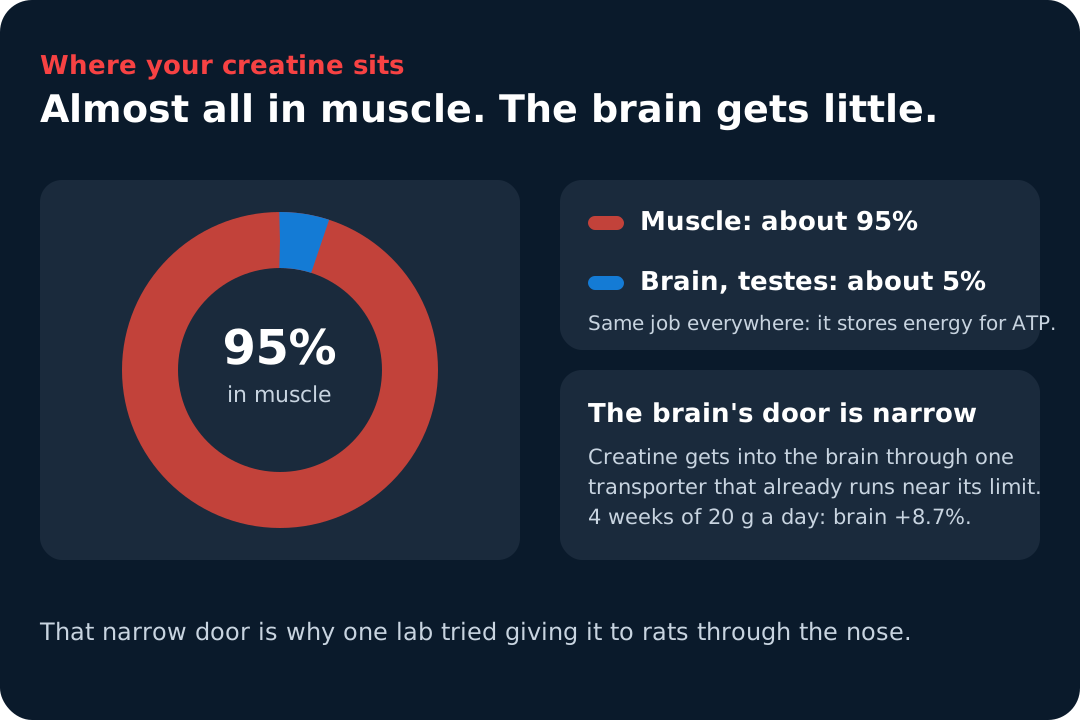
Normal supplementation does move it a little. In 6 people who took 20 g a day for 4 weeks, brain creatine went up by 8.7% on average. Muscle levels rise much more on the same dose.
The rat study: creatine through the nose
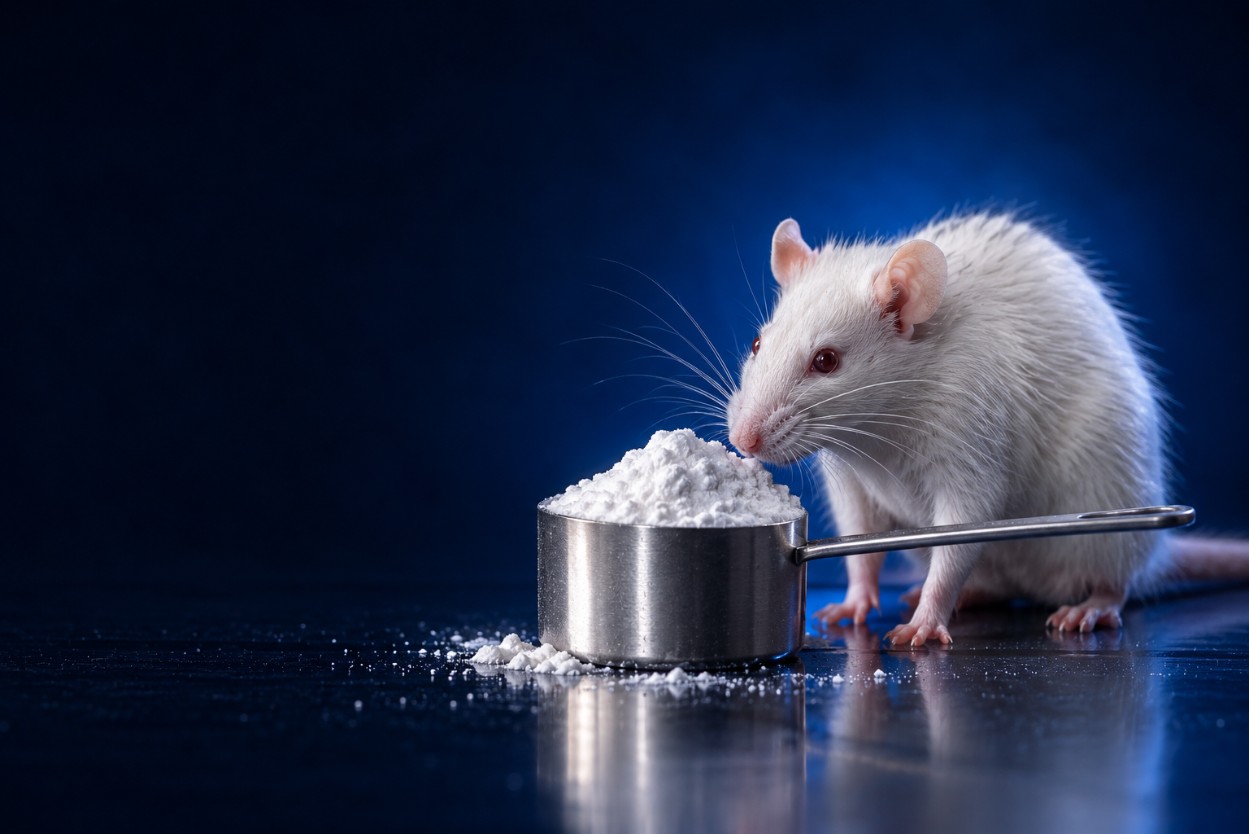
In 2023, researchers at the University of California, Riverside split rats into three groups: creatine through the nose, creatine by mouth, and no creatine. The creatine was creatine hydrochloride.
Then they put the rats in a Barnes maze, a round table with holes around the edge where one hole leads to a hidden escape box. The rats have to learn and remember which one.
What they found:
- The nose rats learned faster. They made fewer errors than the rats with no creatine, and found the exit faster than the rats that swallowed it.
- They remembered better. In the final memory test, the nose rats spent more time near the right spot than the rats with no creatine.
- More creatine reached the brain. The nose group had more creatine in the smell centre, the front of the brain and the hippocampus, the memory area, than both other groups.
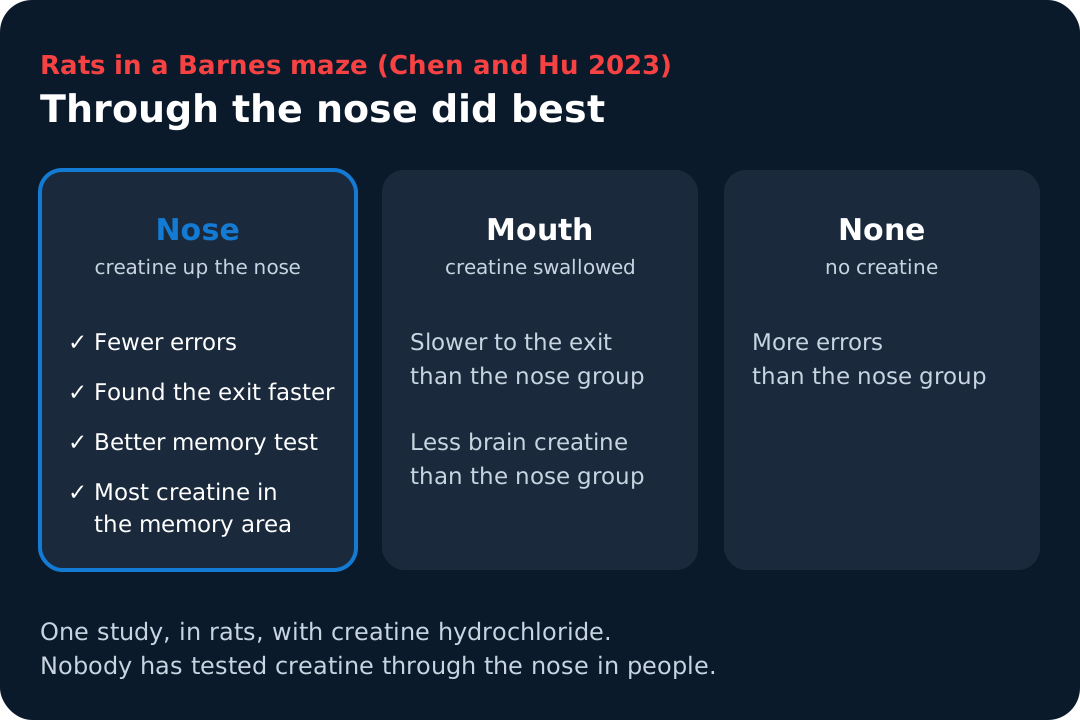
The authors' conclusion: creatine hydrochloride through the nose "increases the creatine level in the rat's brain's and improves their performance in the Barnes maze".
The honest version: this is one study in rats, with creatine hydrochloride, not the creatine monohydrate in your tub. No published study has tested creatine through the nose in people. The nose is also a delicate place for powder: nothing here says snorting what you buy is safe.
The human study: one big dose, no sleep
The more useful study for you was done in people, and it skipped the nose.
At the Jülich research centre in Germany, 15 healthy young adults did memory and thinking tests in the evening, then stayed awake through the night, 21 hours in total. They did this twice, at least 5 days apart. One night they got a placebo. The other night they got one big dose of creatine monohydrate to swallow: 0.35 g per kg of body weight. Neither they nor the researchers knew which night was which.
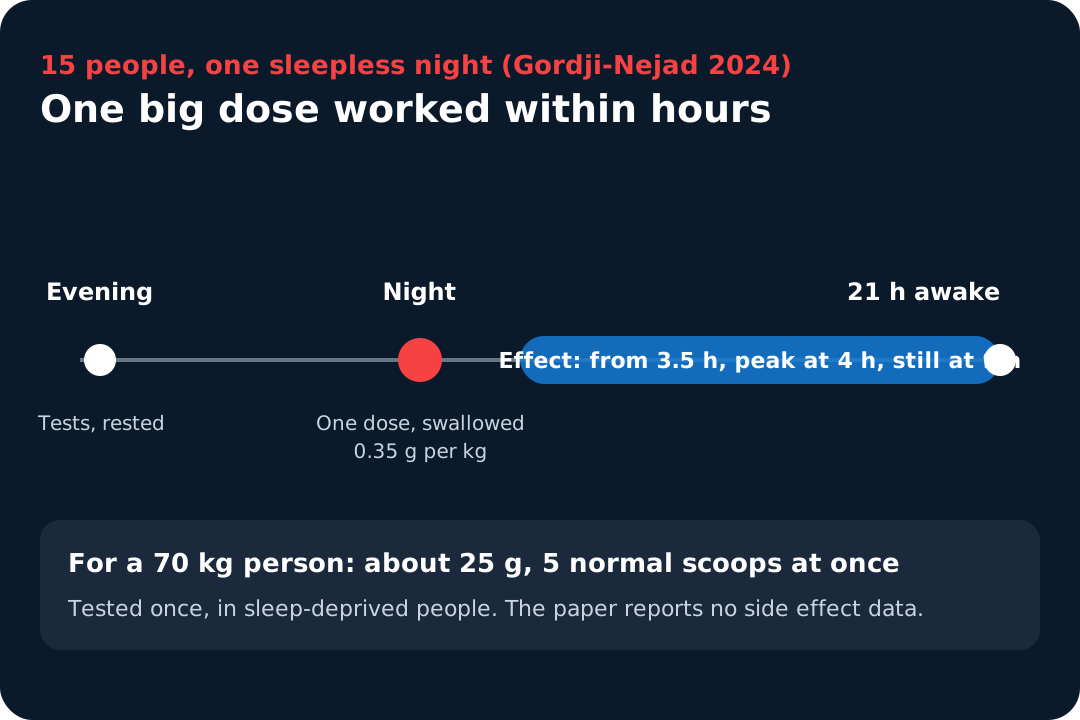
For a 70 kg person, 0.35 g per kg is about 25 g, or 5 normal 5 g scoops at once.
What happened on the creatine night:
- The brain's energy chemistry changed. Brain scans showed more phosphocreatine relative to phosphate, and a drop in measured ATP, which the authors explain as the energy system shifting. Brain pH didn't fall the way it did on placebo.
- Memory and speed improved. Cognitive performance and processing speed got better compared with placebo.
- It worked within hours. The effects showed up from the first test, 3.5 hours after the dose, peaked at about 4 hours and still held at the last test, 9 hours after.
- Some results beat the baseline. The authors write that the improvements in performance and processing speed went "exceeding wake baseline", meaning better than the same people's own tests the evening before, when they were still rested.
Their conclusion: "a high single dose of creatine can partially reverse metabolic alterations and fatigue-related cognitive deterioration". That goes against the usual idea that creatine only works after weeks of taking it.
So should you snort it, or just take more?
The human data says you don't need your nose. A big enough swallowed dose reached the brain fast enough to show up on a scan within hours.
Before you take 25 g at once, know what this study did and didn't test:
- 15 people, one night each. The authors themselves warn that the sample is small.
- Only while sleep deprived. The effect showed up in brains under stress from no sleep. Nobody tested this dose on a normal day.
- No side effect data. The paper doesn't report how people tolerated the dose. In a study of football players, 10 g in one serving already doubled the rate of diarrhoea compared with 5 g servings, 55.6% vs 28.6%. 25 g at once is far beyond that.
What the evidence supports for daily use: 3 to 5 g a day keeps your muscle stores full, and doses up to 30 g a day for 5 years have been safe in healthy people. For memory, a 2023 meta-analysis found a small benefit overall, mostly in older adults, and almost none in people under 31. Other researchers have questioned how that analysis counted the studies, so treat the memory effect as possible, not proven.
The short answer: don't snort it. If you want creatine in your brain, the human evidence points to swallowing it, regularly, and to bigger single doses only being tested for one sleepless night.
I don't gatekeep.
Tell me what you're after and where you live. I'll email you my source.
Sources 7 studies and labels
- Chen and Hu (2023). Intranasal creatine administration increases brain creatine level and improves Barnes maze performance in rats. Brain Research Bulletin. PubMed 37429386
- Kreider et al. (2017). International Society of Sports Nutrition position stand: creatine supplementation. full text
- Gordji-Nejad et al. (2024). Single dose creatine improves cognitive performance and induces changes in cerebral high energy phosphates during sleep deprivation. Scientific Reports. full text
- Dechent et al. (1999). Increase of total creatine in human brain after oral supplementation. American Journal of Physiology. PubMed 10484486
- Ostojic and Ahmetovic (2008). Gastrointestinal distress after creatine supplementation in athletes. Research in Sports Medicine. PubMed 18373286
- Prokopidis et al. (2023). Effects of creatine supplementation on memory in healthy individuals, systematic review and meta-analysis. Nutrition Reviews. PubMed 35984306
- Eckert et al. (2023). Letter to the editor: double-counting in the creatine and memory meta-analysis. Nutrition Reviews. PubMed 36644917