How to mix your peptides, and should you shake them?
Every guide says the same thing: drip the water down the side, swirl it slowly, never shake. That rule comes from the labels of big proteins like growth hormone. Here is the full mixing routine, step by step from the labels of approved peptide drugs, and what is actually known about shaking.

In short
- Add the water slowly against the side of the vial, swirl or roll gently, then check the liquid is clear
- Bacteriostatic water keeps a vial usable over several doses. Store mixed vials in the fridge
- The never-shake rule comes from growth hormone, a folded protein of 191 amino acids that can be damaged by shaking
- BPC-157 has 15 amino acids, ipamorelin 5. The founder of the Janoshik test lab calls the shaking rule a myth
- Some approved peptides, like tesamorelin and hCG, really do say do not shake on the label
Where the never-shake rule comes from
The rule is real, for the right product. Growth hormone is a protein of 191 amino acids, folded into a precise shape. Its label says it plainly: "Do not shake; shaking may cause denaturation of the active ingredient".
What shaking does to a big protein: it pushes the protein up to the surface where the liquid meets the air. There the protein can partly unfold and show its water-hating core, and the unfolded pieces stick together into clumps. In one test, growth hormone mixed on a vortex for just one minute lost up to 67% of its protein as clumps.
What about short peptides?
Most of the peptides people mix at home are much smaller:
| Peptide | Size |
|---|---|
| Growth hormone | 191 amino acids, folded protein |
| Tesamorelin | 44 amino acids |
| BPC-157 | 15 amino acids |
| Ipamorelin | 5 amino acids |
| GHK-Cu | 3 amino acids plus copper |
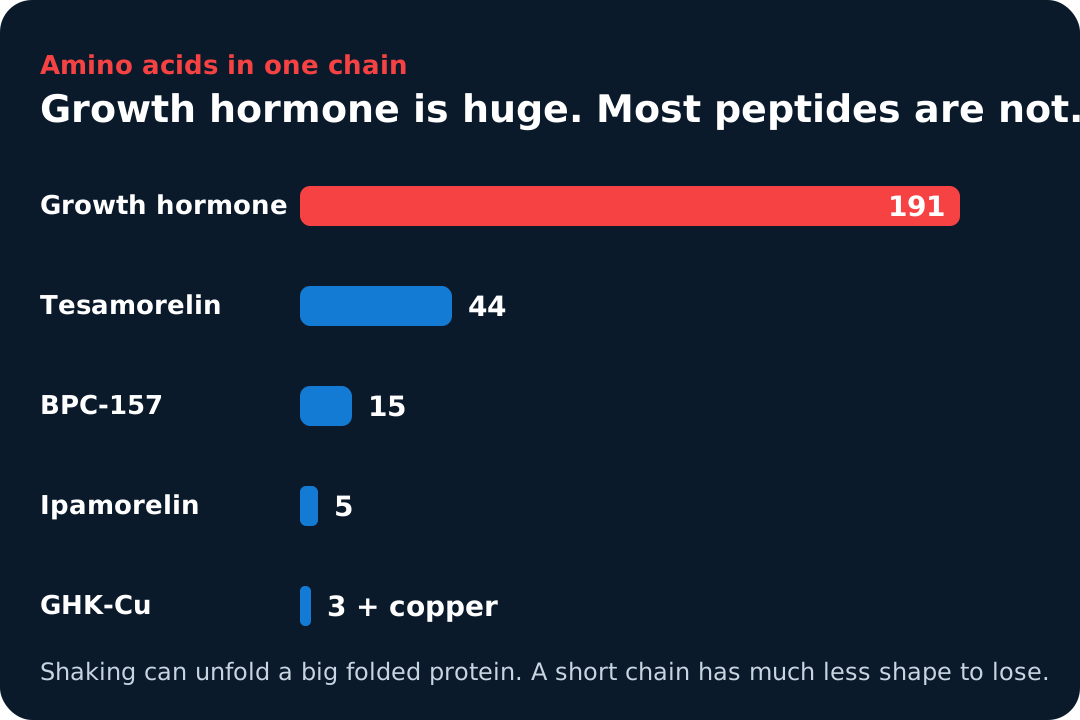
A chain of 15 or 5 amino acids has very little folded shape to lose. That is the argument for why the rule may not matter for them.
What the Janoshik founder says. Peter Magic runs Janoshik, one of the best-known labs that test peptides for buyers. Asked in a 2025 interview whether you can shake your peptides and squirt the water straight onto the powder, he answered: "Yes, go ahead, without fear." He added: "I am not aware of any peptide in our field of work that is sensitive. There are peptides that are sensitive, but none of them are in this business sector." He called the idea that peptides are extremely sensitive to shaking "a myth perpetuated by those who sell low-quality growth hormone". That is the view of someone who tests thousands of vials, not a study. He showed no data in the interview.
What the studies say. We found no study that tested shaking on BPC-157, ipamorelin or GHK-Cu, either way. For other small peptides the answer depends on how hard you shake. Liraglutide, 31 amino acids, showed minimal change under mild shaking, and only formed clumps under strong shaking with a lot of air and silicone oil in the syringe. The same paper says the effect of this kind of stress on peptide drugs is still "underexplored".
Some peptides really must not be shaken. The labels of approved tesamorelin say "Do not shake", and so does the hCG label: "agitate gently until powder is completely dissolved in solution. Do not shake". For cetrorelix, a 10 amino acid peptide, the label gives a different reason: "Do not shake or you will create bubbles in your medicine".
The honest version: for short peptides like BPC-157, ipamorelin or GHK-Cu, a shake probably doesn't ruin them, but nobody has proven it either way. Swirling costs you 30 seconds, so swirl anyway. For anything with a label, like tesamorelin, hCG or growth hormone, follow the label.
How to mix a peptide, step by step
These steps come from the labels of approved peptide drugs. They are the safe default for any vial of powder.
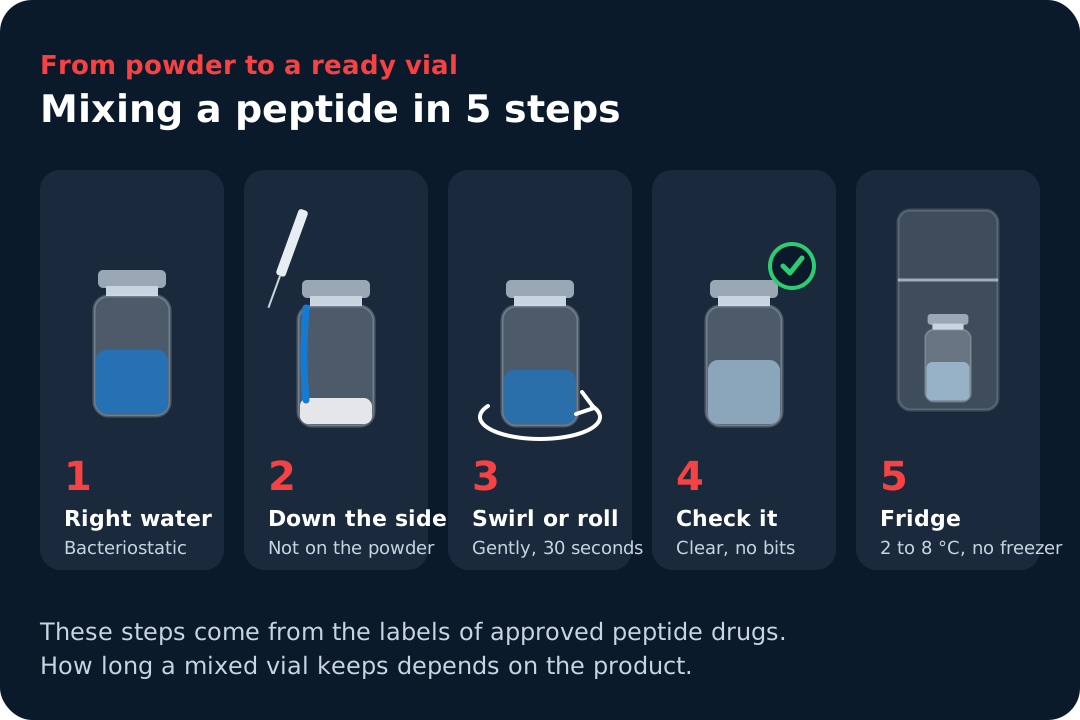
1. Use the right water
Bacteriostatic water is sterile water with 0.9% benzyl alcohol, which stops bacteria growing, so one vial can be used over several doses. Some labels ask for it by name. Plain sterile water has no preservative and is meant for a vial you use up straight away.
2. Let the water run down the side
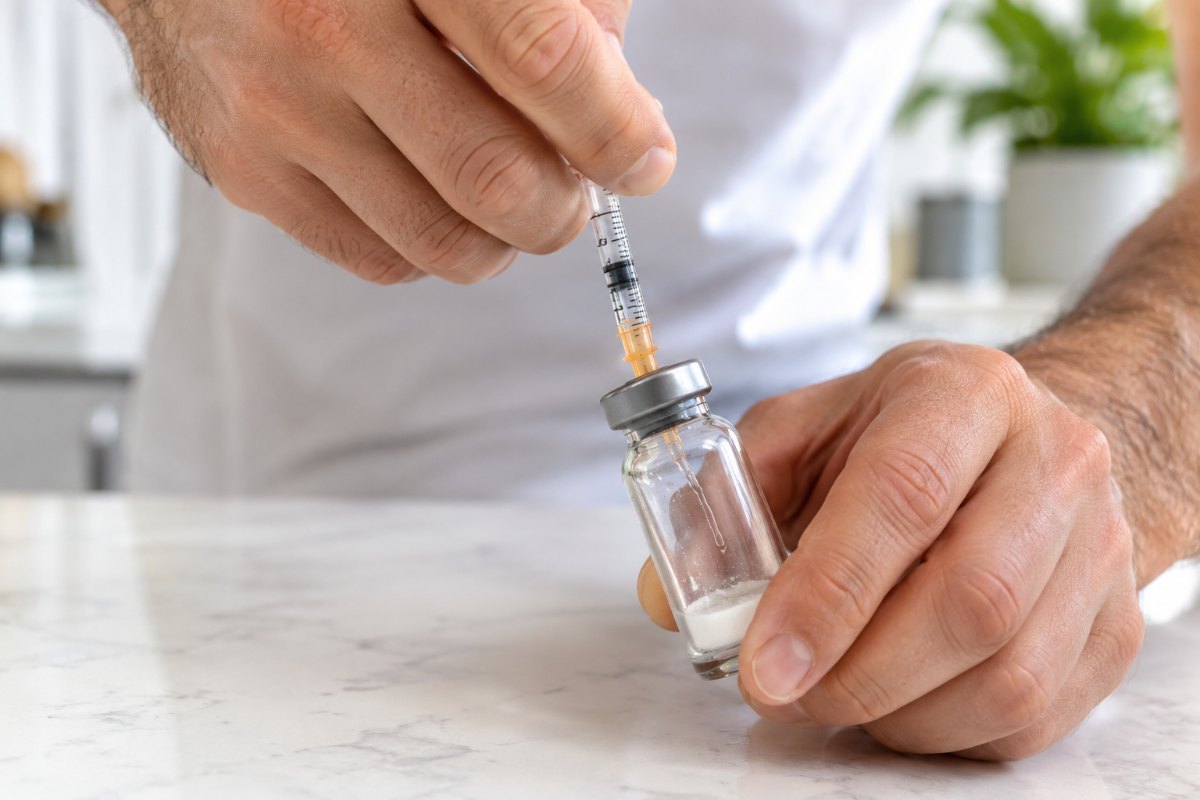
Push the water in slowly and aim it at the glass wall, not straight onto the powder. One growth hormone label says: "Aim the stream of diluent against the side of the vial to prevent foaming".
3. Swirl or roll, gently
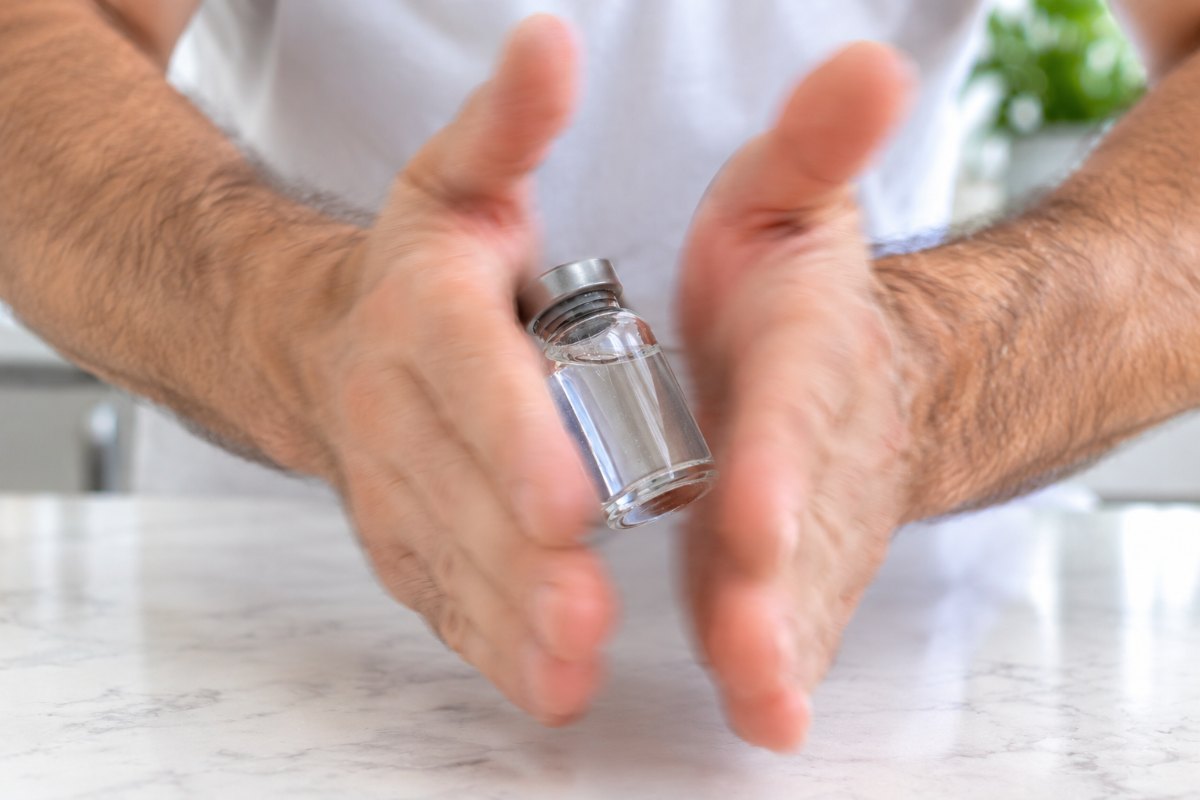
Move the vial in small circles, or roll it between your palms. The tesamorelin label: "Mix by rolling the vial gently in your hands for 30 seconds".
4. Wait, then look at it
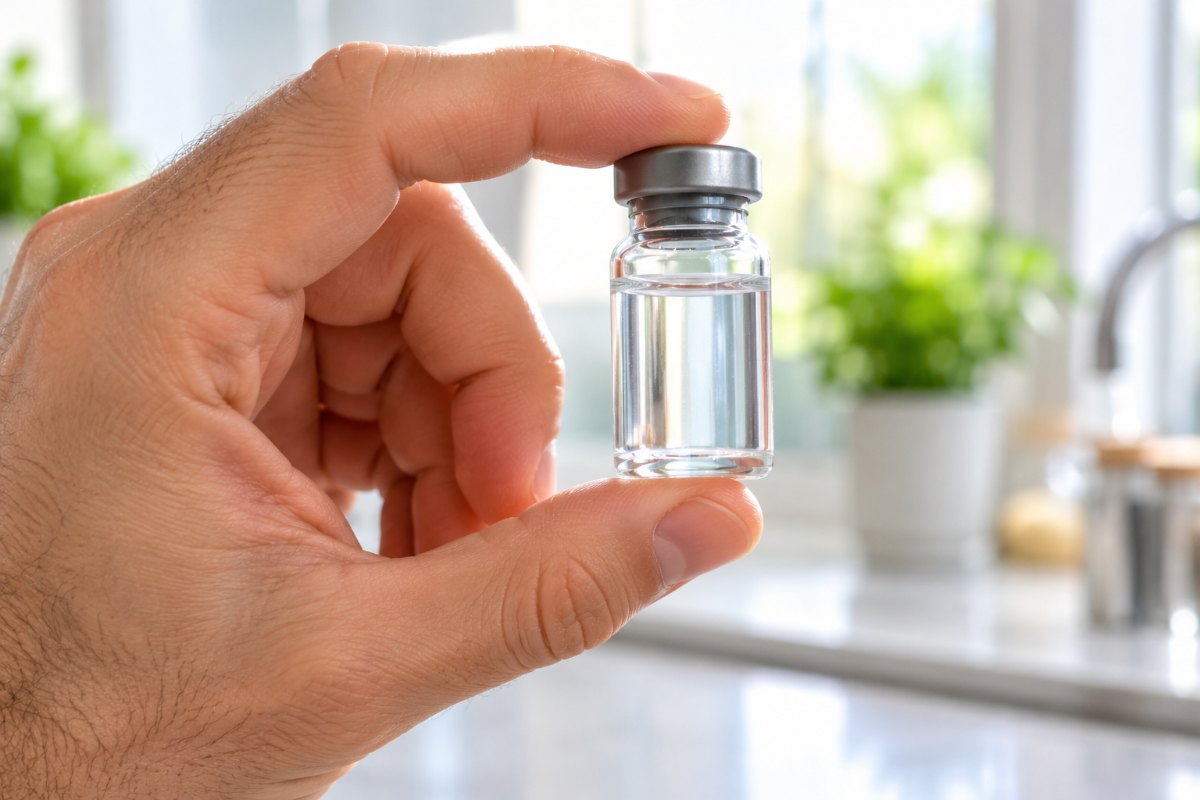
Give it a few seconds for any foam to settle. It should be clear, colourless and without bits floating in it. If it stays cloudy or has particles, the labels say not to use it.
5. Into the fridge
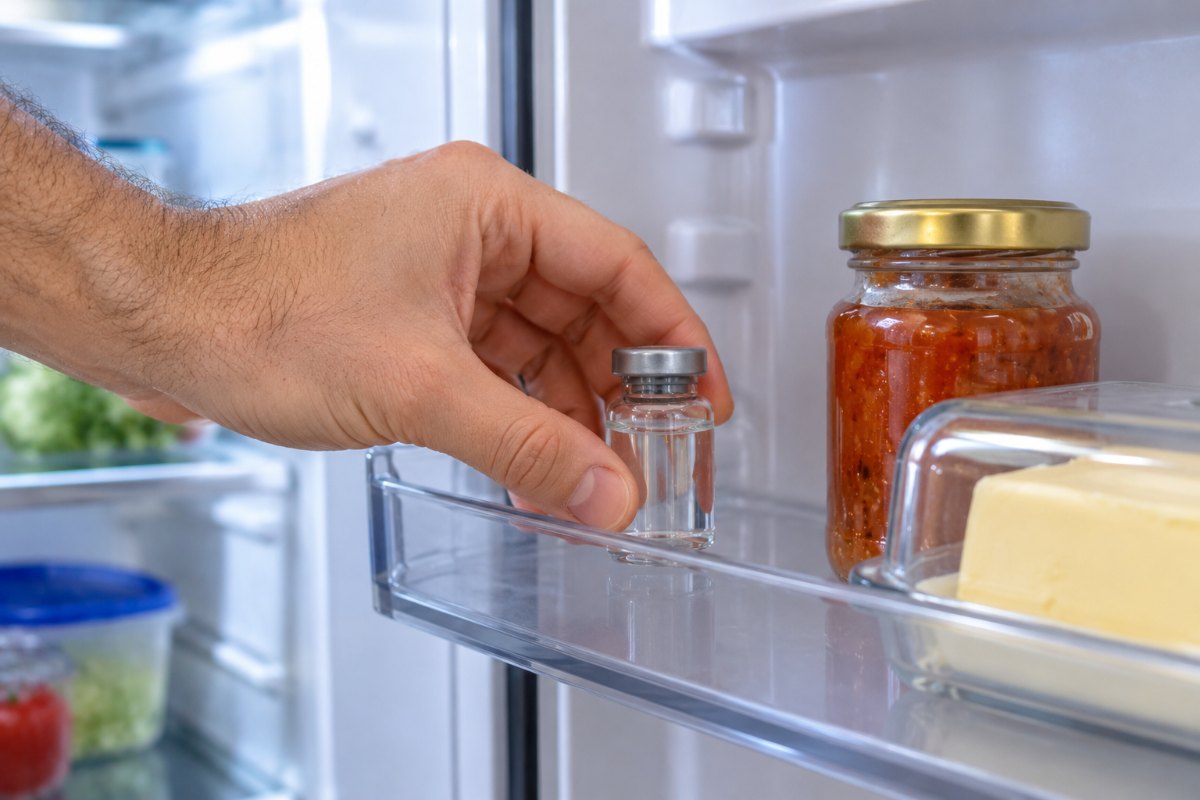
Once mixed, keep the vial in the fridge at 2 to 8 °C and don't freeze it. How long it lasts depends on the product: the hCG label says 60 days, another hCG label 30 days, growth hormone 28 days. Peptides sold without a label have no tested shelf life after mixing, so these numbers are examples, not a rule for them.
How much water, and how many units
The water you add doesn't change how much peptide is in the vial, only how much liquid it is spread across. More water means each unit on the syringe holds less peptide.
The math, with an example:
- Strength of the mix: peptide in the vial ÷ water added. A 5 mg vial with 2 ml of water = 2.5 mg per ml.
- On an insulin syringe: a standard U-100 insulin syringe has 100 units in 1 ml, so 10 units = 0.1 ml.
- Your dose in units: at 2.5 mg per ml, 0.1 ml (10 units) holds 0.25 mg, which is 250 micrograms.
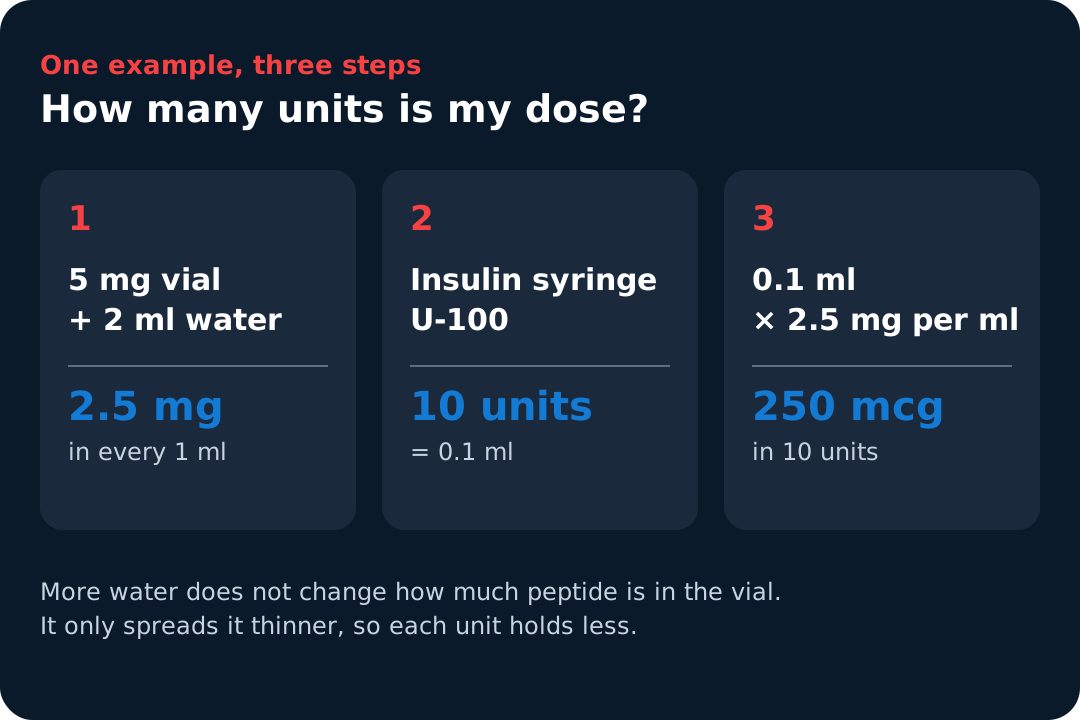
Do it once on paper before your first shot, and write the number of units on the vial.
I don't gatekeep.
Tell me what you're after and where you live. I'll email you my source.
Sources 14 studies and labels
- Genotropin (somatropin) US label. DailyMed
- Li et al. (2019). Interfacial stress in the development of biologics. AAPS Journal. full text
- Egrifta SV (tesamorelin) US label. DailyMed
- Egrifta WR (tesamorelin) US label. DailyMed
- Sikiric et al. (2011). Stable gastric pentadecapeptide BPC 157. Current Pharmaceutical Design. PubMed 21548867
- Raun et al. (1998). Ipamorelin, the first selective growth hormone secretagogue. European Journal of Endocrinology. PubMed 9849822
- Pickart et al. (2015). GHK peptide as a natural modulator of multiple cellular pathways. BioMed Research International. PubMed 26236730
- PepTok, interview with Peter Magic, founder of Janoshik Analytical (25 August 2025). YouTube
- Hamada et al. (2026). Agitation, headspace and silicone oil and the fibrillation of liraglutide. Molecular Pharmaceutics. PubMed 41572471
- Pregnyl (chorionic gonadotropin) US label. DailyMed
- Cetrotide (cetrorelix) US label. DailyMed
- Novarel (chorionic gonadotropin) US label. DailyMed
- Zomacton (somatropin) US label. DailyMed
- Humatrope (somatropin) US label. DailyMed