Should you snort your peptides? The ones that are made for the nose
Most peptides are made as shots or pills. A handful were made to go up the nose, and one of them, Semax, is a registered medicine in Russia that is sold only as nose drops. Here is what the studies show, and the full list of peptides that are approved as nasal sprays.

In short
- Semax is registered in Russia as nose drops. Russian labels list it for acute stroke and recovery after stroke
- In a 2006 rat study, one dose of Semax raised the brain protein BDNF in the memory area by up to 40%
- The nose may be a shortcut to the brain. It is well shown in animals and still debated in people
- Approved nasal peptides include desmopressin, salmon calcitonin, nafarelin, glucagon and, in Russia, Selank
- Most peptides are too big to cross the nose lining well. Even approved sprays reach the blood at only a few percent
- Orexin A has a few small nose studies. Orexin B and DSIP by nose rest on theory and user reports
Semax: the peptide that is sold as nose drops
Semax is a short peptide of 7 amino acids, built from a piece of the stress hormone ACTH. It is one of 14 peptide drugs registered in Russia, and it comes as nose drops, put in with a dropper.
Russian doctors use it after strokes. The Russian product information lists the 1% drops for the acute phase of an ischemic stroke and the 0.1% drops for the recovery period after a stroke. A review of Russian peptide drugs puts it plainly: "The Semax peptide is used to treat ischemic stroke".
The human studies behind that use are Russian and small. In one, 110 stroke patients were followed during rehabilitation, and those who also got Semax had higher BDNF in their blood and recovered movement faster. We found no approval for Semax in the US or the EU.
Why the nose: a shortcut to the brain
Your brain sits behind the blood-brain barrier, a tight wall that keeps most molecules in the blood out. The nose is different. It is the one place where nerves from the brain end right next to the outside world, and researchers think some molecules can travel along those nerves straight to the brain. A 2022 review describes it as a "shortcut" from the nose to the brain that bypasses the barrier.
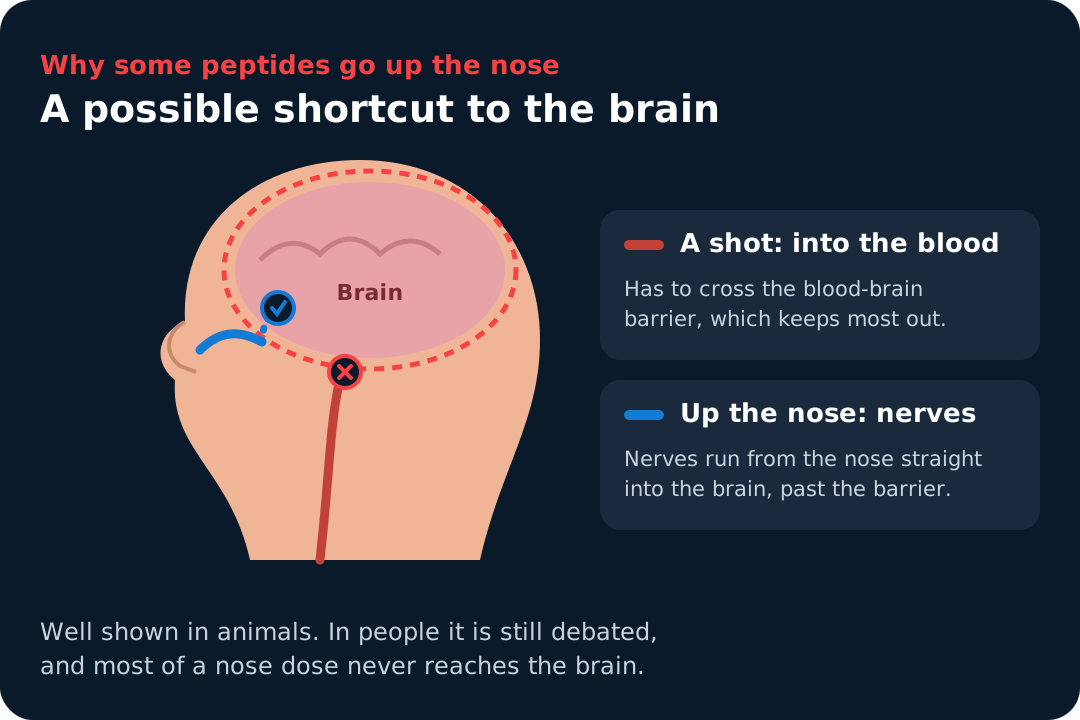
That is the idea behind Semax drops. How well it works in people is less clear. A 2020 review warns that results in animals are "not readily transferable to humans" because our noses and brains are built differently.
The BDNF study: what it really showed
BDNF (brain-derived neurotrophic factor) is a protein that helps brain cells grow and connect. It matters most in the hippocampus, the part of the brain that stores memories.
In 2006, researchers gave rats a single dose of Semax, 50 micrograms per kilo of body weight. In the hippocampus, BDNF protein went up by as much as 1.4 times, about 40%. The gene for BDNF was switched on about 3 times more, and the treated rats did better on a learning task. A second study from the same team that year put Semax into the nose and saw BDNF rise within 3 hours in another part of the rat brain.
The honest version: the 40% is real, it is the peak value, and it was measured in rat brains. Nobody has measured BDNF inside a human brain after Semax. The human data is BDNF in the blood of stroke patients.
Other peptides made for the nose
Semax is not the only one. These peptides are, or were, approved as nose sprays or drops:
| Peptide | Size | What it is for | Where |
|---|---|---|---|
| Semax | 7 amino acids | Stroke, recovery after stroke | Russia |
| Selank | 7 amino acids | Anxiety | Russia, nose drops |
| Desmopressin | Copy of the hormone vasopressin | Diabetes insipidus, some bleeding disorders | US and others |
| Salmon calcitonin | 32 amino acids | Osteoporosis after menopause | US |
| Nafarelin (Synarel) | 10 amino acids | Endometriosis, early puberty in children | US |
| Glucagon (Baqsimi) | 29 amino acids | Emergency for very low blood sugar | US |
| Buserelin | Copy of the hormone GnRH | Endometriosis | UK, Canada and others, withdrawn in some |
| Oxytocin (Syntocinon spray) | Copy of the hormone oxytocin | Older use, now mostly gone | Still listed in Switzerland |
Note that only Semax and Selank are given by nose to reach the brain. Glucagon, calcitonin and desmopressin go up the nose simply because it is easier than a needle, and they work through the blood.
Two that are only research. Insulin up the nose has been tested for memory. A small 2012 trial in people with early memory loss saw a benefit, but a bigger 2020 trial of 289 people found "no cognitive or functional benefits" over 12 months. Nasal oxytocin is widely used in behaviour studies, but researchers point out that "very little" of it reaches the fluid around the brain.
Used by nose with little or no proof
Some peptides are taken as nose sprays even though they were never approved that way. Here is what the studies behind them actually show.
Orexin A. Orexin A (also called hypocretin-1) is the brain's own "stay awake" signal. People with narcolepsy lose the cells that make it. Of all the peptides on this list, it has the most nose data, and it is still small:
- In rhesus monkeys kept awake for 30 to 36 hours, orexin A sprayed into the nose improved their memory test scores. The nose spray worked better than the highest dose given into a vein.
- In 7 people with narcolepsy, a nose dose brought their sense of smell back toward normal.
- In 8 people with narcolepsy, it cut REM sleep and made sleep more stable, but didn't make them more awake at night. In 14 people, it stabilised REM sleep and they made fewer mistakes on an attention test.
- In 10 healthy men, a nose dose raised the nerve activity that tightens blood vessels, without changing blood pressure or heart rate.
All of these are pilot studies with a handful of people. None tested orexin A as a stay-awake or focus aid in healthy people.
Orexin B. The second orexin, made by the same cells. We found no study that gave orexin B through the nose, in animals or people. Using it that way is theory: it is a short peptide with the same job, so it might travel the same route.
DSIP (delta sleep-inducing peptide). Sold as a sleep peptide and often used as a nose spray. In its one double-blind sleep trial, 16 people with chronic insomnia got DSIP into a vein for three nights. The effects were weak, and the authors concluded it "is not likely to be of major therapeutic benefit". By nose, there is only one short 2001 report in people, which measured a brain wave signal and not sleep. Using DSIP by nose for sleep rests on user reports.
Why most peptides don't go up the nose
Two reasons: size and how little gets through.
The nose lining lets small molecules through far better than big ones. Absorption through it drops off for anything heavier than about 1,000 daltons. Semax and Selank, at 7 amino acids, are under that line. Most peptides people use are bigger.
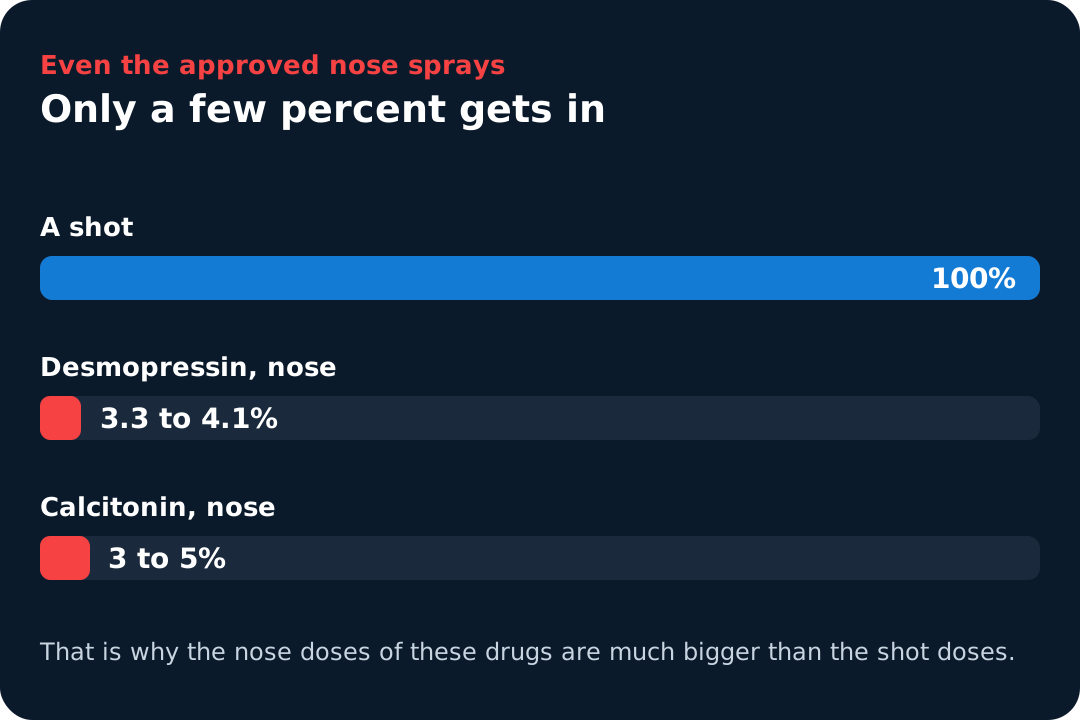
Even the approved sprays don't get much in. Only 3.3 to 4.1% of a desmopressin nose dose reaches the blood. For salmon calcitonin it is 3 to 5% of what a shot into the muscle delivers. That is why those drugs use much bigger doses in the nose than in a shot.
So should you snort your peptides? Only the ones that were made for it. A peptide that was built and tested as a shot has no study showing it works the same way up the nose, and for most of them the nose lets through only a small share of the dose.
I don't gatekeep.
Tell me what you're after and where you live. I'll email you my source.
Sources 26 studies and labels
- Deigin et al. (2022). Development of peptide biopharmaceuticals in Russia. Pharmaceutics. full text
- RLS drug reference (Russia), Semax 1% nasal drops. rlsnet.ru
- RLS drug reference (Russia), Semax 0.1% nasal drops. rlsnet.ru
- Gusev et al. (2018). Semax, BDNF and rehabilitation after ischemic stroke. Zh Nevrol Psikhiatr. PubMed 29798983
- Alabsi et al. (2022). Nose-to-brain delivery of therapeutic peptides as nasal aerosols. Pharmaceutics. full text
- Trevino et al. (2020). Non-invasive strategies for nose-to-brain drug delivery. Journal of Clinical Trials. full text
- Dolotov et al. (2006). Semax regulates BDNF and trkB expression in the rat hippocampus. Brain Research. PubMed 16996037
- Dolotov et al. (2006). Semax, intranasal, BDNF in the rat basal forebrain. Journal of Neurochemistry. PubMed 16635254
- RLS drug reference (Russia), Selank 0.15% nasal drops. rlsnet.ru
- Desmopressin nasal spray, US label. DailyMed
- Stimate (desmopressin) nasal spray, US label. DailyMed
- Calcitonin salmon nasal spray, US label. DailyMed
- Synarel (nafarelin) nasal solution, US label. DailyMed
- Baqsimi (glucagon) nasal powder, US label. DailyMed
- HPRA Ireland, Suprecur (buserelin) nasal spray, withdrawn medicines. hpra.ie
- Swissmedic, Syntocinon nasal spray supply notice (2026). swissmedic.ch
- Craft et al. (2012). Intranasal insulin in mild cognitive impairment and early Alzheimer's disease. Archives of Neurology. PubMed 21911655
- Craft et al. (2020). Safety, efficacy and feasibility of intranasal insulin, a randomized trial. JAMA Neurology. PubMed 32568367
- Leng and Ludwig (2016). Intranasal oxytocin: myths and delusions. Biological Psychiatry. PubMed 26049207
- Deadwyler et al. (2007). Systemic and nasal delivery of orexin-A reduces the effects of sleep deprivation on cognitive performance in nonhuman primates. Journal of Neuroscience. PubMed 18160631
- Baier et al. (2008). Olfactory dysfunction in narcolepsy is restored by intranasal orexin A. Brain. PubMed 18718966
- Baier et al. (2011). Effects of intranasal hypocretin-1 (orexin A) on sleep in narcolepsy with cataplexy. Sleep Medicine. PubMed 22036605
- Weinhold et al. (2014). Intranasal orexin-A on sleep, wakefulness and attention in narcolepsy with cataplexy. Behavioural Brain Research. PubMed 24406723
- Meusel et al. (2022). Intranasal orexin A modulates sympathetic vascular tone, a pilot study in healthy men. Journal of Neurophysiology. PubMed 35044844
- Bes et al. (1992). Effects of delta sleep-inducing peptide on sleep of chronic insomniac patients, a double-blind study. Neuropsychobiology. PubMed 1299794
- Hruz et al. (2001). Intranasal administration of delta sleep-inducing peptide increases P300. Journal of Clinical Psychopharmacology. PubMed 11763019